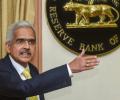
Taking advantage of the RBI's different accounting year, the Centre had started demanding an interim dividend till the time the latter's final balance sheet is prepared (usually in August). To address this anomaly, an expert committee led by former RBI governor Bimal Jalan had recommended aligning the RBI's financial year with that of the government.
'If you do quick back-of-the-envelope calculation, someone earning Rs 10 lakh can get a benefit of anywhere between Rs 35,000 and Rs 45,000, even if s/he is availing exemptions.' 'A large proportion of people do not avail full exemptions as they don't have money to invest in those schemes.'
'There are some encouraging signs.' 'Notice that we have not said 7%-plus, we are keeping it at 6% to 6.5%.'

Facebook-owned messaging service WhatsApp has secured regulatory approval for launching its digital payment platform -- WhatApp Pay -- in a phased manner, close to two years after the US-based company's pilot run.
The panel may include or seek inputs from former RBI Governor Urjit Patel, former chief economic advisor Arvind Subramanian, Sajjid Chinoy of the PM-EAC, Rathin Roy, among others.

The government has found about 900,000 beneficiaries of its flagship job formalisation scheme, the PMRPY, were ineligible in the first place as they were part of the formal economy even before the inception of the scheme. The EPFO has also recovered Rs 222 crore so far from the employers concerned.

The proposed measures aim to bring stricter norms to curb holding of illegal cash and mismanagement of unaccounted cash seized by the probe agencies during investigations.
The ministry said it was an anti-abuse provision amid growing instances of NRIs shifting their stay in low or no-tax jurisdiction to avoid tax payment in India.

'The banks cannot pass on the hike in premiums to its customers, according to the norms. The premium won't go up substantially in any case and may be hiked to 12-13 paise (per deposit of Rs 100 a year),' Finance Secretary Rajiv Kumar said.

This is due to the newly formed Union Territories of Jammu and Kashmir, and Ladakh, which will get funds from the Centre's share, which means devolution will be for 28 states compared to 29 earlier.
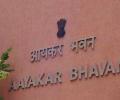
The Vivaad se Vishwas scheme is a replica of the Sabka Vishwas (Legacy Dispute Regulation) Scheme, 2019 (SVLDRS) for indirect tax litigation. The hope is that this would unlock revenue blocked in long-drawn litigation at various forums. Sources in the department say the total value at stake in these disputes would be Rs 5-6 trillion.
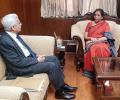
This demand comes at a time when the government is falling short of its revenue targets due to dwindling tax and low disinvestment receipts. It could account for the dividend in the upcoming Union Budget on February 1. RBI is, however, yet to take a final call on the government's demand and might decide on this at its central board meeting scheduled for February 15 in New Delhi.
Any reduction in devolution could aggravate the strained relations between the Centre and some opposition-ruled states on a number of issues, including CAA.

The ED, which is probing the DHFL promoters' role in financing funds to gangster Iqbal Memon (alias Iqbal Mirchi), said Kapil Wadhawan, former chairman and managing director of the debt-laden company, played a very crucial role in these "nefarious transactions" by way of money laundering.
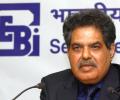
The finance ministry has put out an advertisement seeking applications from eligible candidates for the post and gave just two weeks against the usual practice of three months. Further, the tenure of the watchdog is again being extended to five years.

Processes are at an advanced stage for a number of assets of the Centre and central public sector enterprises (CPSEs) to be monetised. The assets include office space, apartments, factories, land, power transmission assets, sports stadia, gas pipelines, and telecom assets.

It had declined by slightly over 4 per cent in December. The city contributes 37 per cent to the total direct tax revenues. If the trend continues, it could affect the Budget estimates of Rs 13 trillion for the current fiscal year.
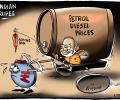
Oil sank to the lowest level in a month after shedding all of its gains from the US-Iran clash as traders waited to see whether any further hostilities will disrupt exports from the East Asia.

The banking regulator is seeking an early exit mechanism for private banks under Prompt Corrective Action.

The new provision under the Income-Tax Act may enable the authorities to seize trustees' personal assets if there's a breach of objectives governing registered charitable trusts.
 © 2025 Rediff.com - Investor Information - Advertise with us - Disclaimer - Privacy Policy - Sitemap - Feedback - About us - Terms of use - Grievances